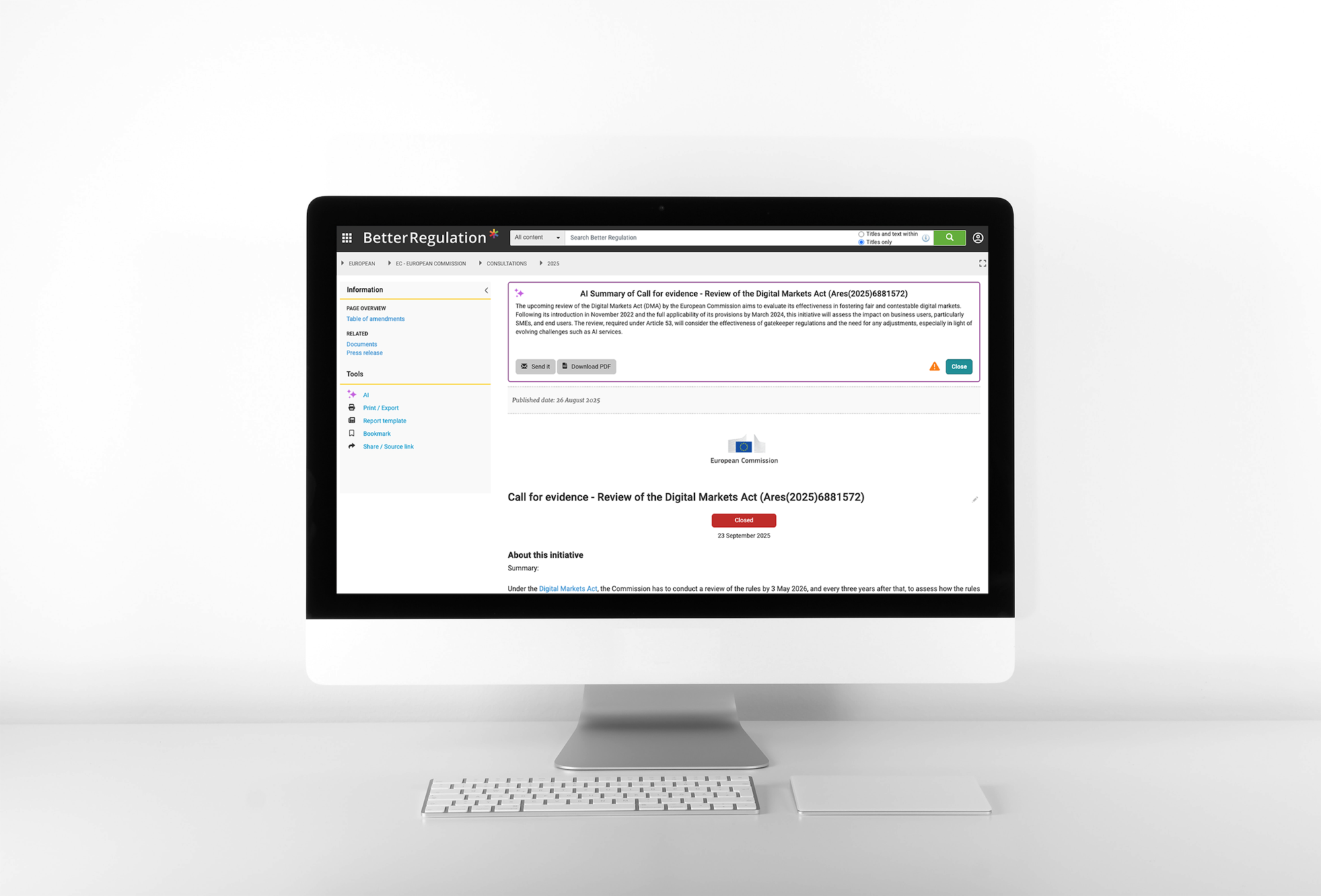
AI-Powered Document Summaries: Delivering Instant Value to Legal Professionals
For Better Regulation, we implemented an AI-powered solution that automatically summarizes complex legal documents and identifies key obligations within them. Built on Drupal and AI Automators, the system replaces time-consuming manual analysis with clear, structured insights, making regulatory content easier to understand, manage, and reuse at scale.
Key results
3 summary types generated
Long overview, short abstract, and obligations extraction.
2-350 pages summarized
Instant insights from documents of any length.
Automatic processing
Background generation requires no editor action.
Obligations extraction
Critical compliance requirements identified automatically.
Phased user rollout
Opt-in approach building trust with subscribers.
Measurable time savings for users
30s relevance check instead of minutes or hours of manual reading.
About Better Regulation
BetterRegulation.com is a comprehensive online compliance platform serving legal professionals, compliance officers, and financial sector experts across the UK and Ireland since 2004.
Their subscription-based platform offers integrated access, among others, to up-to-date national and EU legislation with full amendment histories, as well as international regulatory and accounting standards.
Better Regulation serves professionals such as:
- In-house legal teams at major corporations.
- Law firm practitioners specializing in regulatory law.
- Compliance officers in financial services.
- Financial professionals navigating complex regulations.
- Government and public sector legal advisors.
These professionals face a constant challenge: staying current with legislation while managing overwhelming document volumes.
Challenge: information overload for legal professionals

The user problem: too many documents, too little time
Legal professionals subscribing to Better Regulation face a fundamental challenge: they need to stay current with legislation, but they don't have time to read everything.
The scale of the problem:
- hundreds of new and updated documents published monthly,
- documents ranging from 2 to 350 pages each,
- multiple jurisdictions to monitor (UK, Ireland, EU),
- frequent legislative amendments and updates,
- time-critical information buried in lengthy statutes.
User pain points
"Which documents are relevant to my practice area?"
Lawyers and compliance officers need to quickly identify which of hundreds of new documents matter to their clients or organization.
"What are the key obligations in this 200-page statute?"
Compliance professionals need to extract specific obligations and requirements without reading every page.
"I need a quick overview before diving deep"
Users want to understand a document's relevance and main points before investing time in detailed reading.
"How does this affect my clients?"
Legal advisors need to quickly assess impact and advise clients, often under tight deadlines.
"I'm drowning in regulatory updates"
The sheer volume of legislative changes makes it impossible to read everything comprehensively.
"I can't afford to miss something important"
Legal and compliance professionals fear that critical obligations may be hidden deep in long documents and easily overlooked.
What users needed
The documents themselves presented additional complexities.
Conversations with subscribers revealed clear needs:
- Quick relevance assessment - "Is this document relevant to me?"
- Key points extraction - "What are the main provisions?"
- Obligation identification - "What am I required to do?"
- Time savings - "Help me cover more ground in less time"
- Trust and accuracy - "I need to rely on this information"
Better Regulation needed a solution that would:
- deliver immediate value to subscribers,
- help users navigate document volume,
- maintain the trust and accuracy essential in legal information,
- differentiate their platform from competitors,
- create a foundation for premium features.
Solution: three types of AI-generated summaries

Automatic value addition to every document
Droptica worked with Better Regulation to implement an AI-powered summary system that automatically generates three complementary summary types for every document on the platform.
The solution runs in the background, requiring no editor action, and provides immediate value to users viewing any document.

1. Long summary (~200 characters)
Purpose: comprehensive document overview.
A detailed summary that captures:
- the document's main purpose and scope,
- key themes and provisions,
- context for why the document exists,
- who it affects and how.
Example from actual implementation:
The Bankruptcy Act of 1986 serves as a critical piece of legislation aimed at addressing insolvency and establishing frameworks for bankruptcy proceedings. This act not only sets forth the legal parameters for individuals and businesses in financial distress, but also lays the groundwork for debt resolution. It's essential for legal practitioners to comprehend the intricacies of this act, especially when advising clients on financial recovery or navigating insolvency scenarios.
User benefit: quickly understand whether the document is relevant to their work without opening the full text.

2. Short summary (single paragraph)
Purpose: concise abstract for quick scanning.
A brief, focused summary that:
- highlights the most critical information,
- provides just enough context for decision-making,
- enables rapid scanning of multiple documents,
- helps users prioritize what to read in detail.
User benefit: scan dozens of documents quickly to identify which require detailed reading.
3. Obligations summary (⭐ key differentatior)
Purpose: automatic extraction of legal obligations and requirements
This is the most innovative and valuable summary type. It automatically identifies:
- legal obligations and requirements within the document,
- compliance points that professionals must be aware of,
- relevant license types or affected parties,
- key regulatory requirements extracted from complex text.
User benefit: compliance officers and legal advisors can immediately identify if a document contains obligations relevant to their organization or clients without reading hundreds of pages.
Visual example: AI summary in action
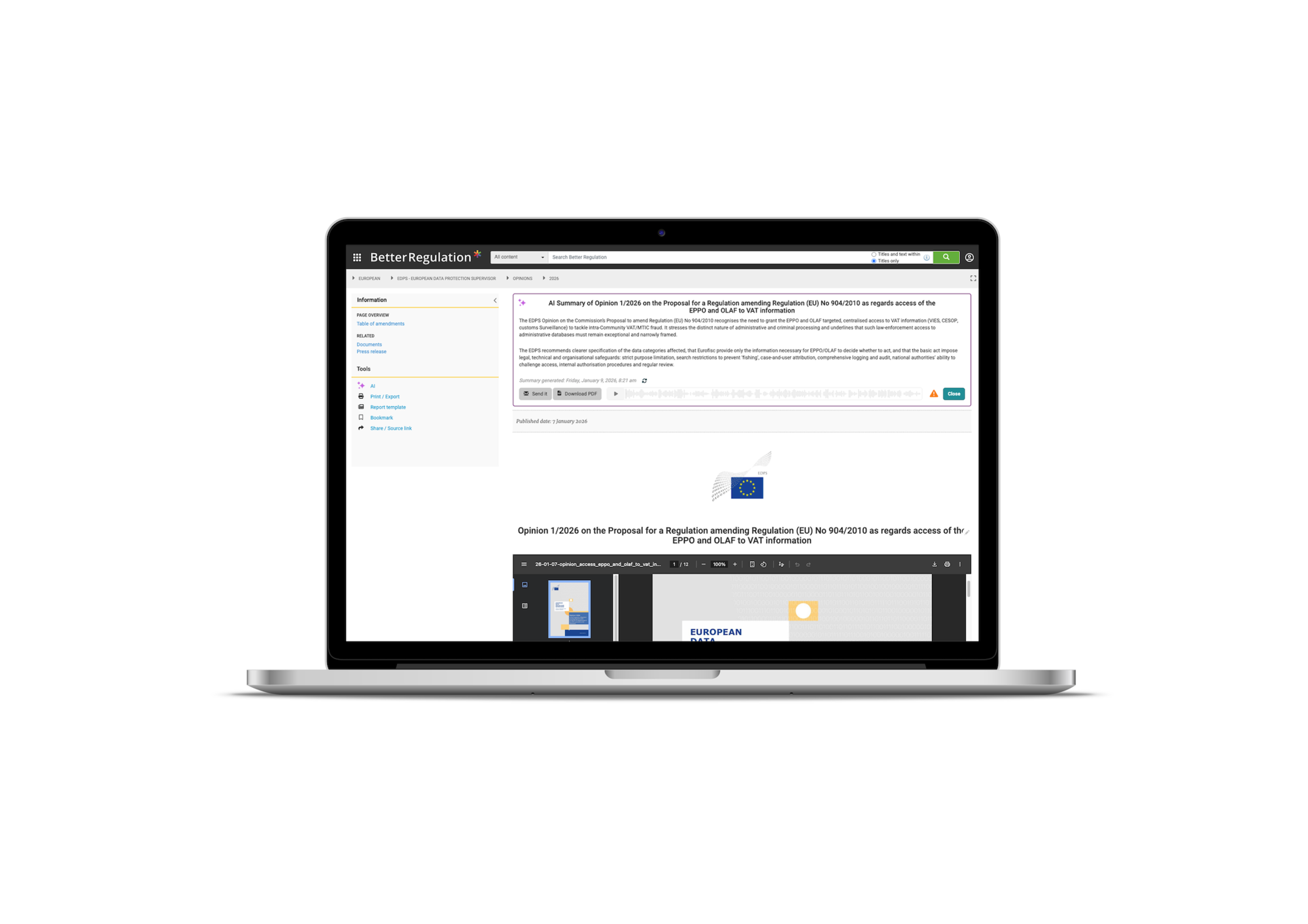
Key elements visible in the interface:
- AI Summary sidebar accessible while viewing the document.
- "AI text summary" and "AI extracted obligations" tabs for different summary types.
- Export options - users can email or download PDF.
- Professional presentation - summaries formatted for easy reading.
- Always available - no additional clicks or waiting required.
How it works: background processing
Trigger: when an editor creates or updates a document.
Processing flow:
- Content save triggers an event.
- Document added to RabbitMQ queue with 15-minute delay.
- The background worker processes documents when ready.
- AI generates all three summary types using optimized prompts.
- Summaries saved to document fields automatically.
- Available immediately to users viewing the document.
15-minute delay purpose: editors often make multiple quick edits to a document.
The delay prevents redundant processing:
- reduces unnecessary API calls,
- lowers processing costs,
- ensures only the final version is summarized,
- no impact on user experience (summaries ready before document is widely viewed).
User experience:
- No waiting - summaries are there when users view documents.
- Always current - automatically regenerated when documents are updated.
- Seamless - integrated into the document viewing experience.
- Reliable - background processing ensures availability.
Technical implementation
Robust architecture
The summary generation uses the same proven technology stack as the document categorization feature:
- Drupal 11 - content management and user interface,
- Drupal Automators - workflow orchestration and prompt management,
- Unstructured.io - clean PDF text extraction,
- GPT - AI analysis and summary generation,
- RabbitMQ - background job queue,
- Watchdog - comprehensive logging.
Optimized for each summary type
Each summary type uses a specialized prompt optimized for its specific purpose:
- long summary prompt,
- short summary prompt,
- obligation prompt.
Continuous improvement
The system is designed for iterative refinement:
- prompts can be updated without code changes,
- new summary types can be added easily,
- processing logic is modular and extensible,
- user feedback informs prompt optimization.
Results: delivering user value and product differentiation
User value: time savings and better coverage
While detailed usage metrics are still being collected during the phased rollout, early feedback indicates significant user value.
Time savings for users:
- Quick relevance assessment: 30 seconds vs. 5-10 minutes of reading.
- Obligations identification: immediate vs. hours of searching through documents.
- Broader coverage: users can review 5-10x more documents in the same time.
- Better prioritization: users know which documents require detailed reading.
Improved user experience:
- Less frustration with document volume.
- More confidence in staying current with changes.
- Better decision-making through broader awareness.
- Higher platform value perception.
Specific use cases from early feedback
Compliance officers
Compliance officers say that the obligations summary is a game-changer. They can immediately see if a new regulation affects their license types without reading the entire document. This has cut regulatory monitoring time significantly.
Law firm practitioners
Law firm practitioners report using the long summaries to quickly assess relevance to their clients. If it looks relevant, then they dive into the full document. The feature functions like having a junior associate do the first pass.
In-house legal teams
In-house legal teams that monitor multiple jurisdictions find that the summaries help them prioritize which legislative changes need immediate attention versus which can wait for detailed review.
Technical performance
Processing reliability:
- Background processing ensures summaries are always available.
- 95%+ success rate in summary generation.
- Graceful handling of edge cases.
- Automatic retry for transient failures.
Quality metrics:
- Very high accuracy in obligation extraction.
- Positive user feedback on summary usefulness.
- Low rate of reported issues or inaccuracies.
- Continuous improvement through prompt refinement.
User engagement:
- High usage rate among opt-in subscribers.
- Regular interaction with summary features.
- Positive feedback in user surveys.
- Feature mentioned in renewal decisions.
Quality assurance process
Human review layer: while summaries are generated automatically, quality is maintained through:
- Sample review: editorial team regularly reviews summary quality.
- User feedback: opt-in users can report issues or inaccuracies.
- Automated checks: validation that summaries meet length and format requirements.
- Continuous monitoring tracks metrics like summary length, processing time, user engagement.
Iterative improvement:
- Collect examples of particularly good summaries.
- Identify patterns in user corrections or feedback.
- Refine prompts based on lessons learned.
- A/B test prompt variations.
- Update as AI models improve.
Integration with Drupal
The technical integration showcases Drupal's flexibility.
Storage:
- Summaries stored in dedicated Drupal fields (long summary, short summary, obligations).
- Fields configured for each content type.
- Revision tracking maintains summary history.
Display:
- Custom Twig templates for summary presentation.
- Responsive design for mobile access.
- Print-friendly formatting.
- Accessibility compliance (screen readers, keyboard navigation).
Permissions:
- Role-based access control (AI Summaries role).
- User permission checks before display.
- Admin visibility controls.
- Usage tracking by user role.
Performance:
- Summaries cached for fast delivery.
- Database indexing for quick retrieval.
- Lazy loading for optimal page speed.
- CDN integration for global access.
Need AI document summaries? Let’s talk!
Book a free consultation to talk about your goals related to AI-powered document summaries.
We’ll contact you to explore how concise, automated summaries can help users quickly understand your documents.