
AI-Powered Document Categorization: How Better Regulation Saved 50% of Editorial Time
We built an AI-driven document categorization engine for Better Regulation that cuts editorial effort in half by automating legal document field extraction and classification. Powered by Drupal Automators and AI, the system transforms hours of manual tagging into a fast, reliable workflow that keeps complex legal content perfectly structured and searchable.
Key results
 50% time saved
Document processing time reduced by half.
1 FTE equivalent saved
Freed editorial capacity for growth.
10s-2min processing time
AI processing vs multiple minutes or hours manually.
2-350 pages handled
Handles documents of all sizes.
Very high accuracy
Minimal corrections needed, <5% of fields require adjustment.
Reduction in cognitive load
AI removes the need for full-document reading.
About Better Regulation
Challenge: the editorial bottleneck

Manual document processing at scale
Processing legal documents for a compliance platform requires meticulous attention to detail. Each statute, regulation, or guidance document needed to be read, categorized, and tagged across approximately 15 different fields – from document type and jurisdiction to year of enactment and organization.
For Better Regulation's editorial team, this manual process created a significant operational bottleneck.

The two-step manual workflow
Before AI implementation, every document followed a labor-intensive process:
Step 1: Document reading and categorization
The editor:
- receives a new legal document (ranging from 2 to 350 pages),
- carefully reads through the entire document to understand its content,
- manually extracts key information: document type, title, year, jurisdiction, organization,
- cross-references with existing taxonomy systems to ensure consistent categorization,
- fills approximately 15 different fields in the content management system.
Time requirement: 15 minutes to multiple hours per document, depending on length and complexity.
Step 2: Quality verification
The second editor:
- reviews all categorizations,
- verifies accuracy of field assignments,
- checks consistency with platform standards.
The pain points
Solution: AI-augmented editorial workflow

The approach: augment, don't replace
Droptica approached this challenge by exploring how AI could augment – not replace – the editorial workflow. Through collaborative discovery sessions with Better Regulation, we focused on a clear objective: eliminate the time-consuming manual reading and data entry tasks while keeping human editors in control of quality and decision-making.
The philosophy was straightforward: let AI handle the tedious, repetitive work, and let humans handle judgment, verification, and quality control.
Discovery and testing phase
Rather than jumping directly to implementation, the Droptica team conducted thorough testing of different approaches to ensure the solution would be reliable, accurate, and production-ready.

PDF processing methods
Legal PDFs are notoriously complex. They often contain:
- multiple columns and complex layouts,
- headers, footers, and page numbers throughout,
- embedded images and graphics,
- tables and structured data,
- various fonts and formatting styles.
We evaluated multiple methods for extracting clean, usable text:
- Direct PDF to ChatGPT API - revealed limitations with complex formatting and file size restrictions.
- Traditional PDF parsing libraries - struggled with inconsistent document structures and produced noisy output.
- Unstructured.io - emerged as the clear winner.
The choice of Unstructured.io proved crucial. The team found that they didn't have control over PDF construction – legal documents often contain numerous formatting markers and metadata that can clog up the context window and confuse the AI. With Unstructured.io, they could filter those out during the extraction phase. The team also saw significantly better accuracy and faster processing speeds compared to other methods.
Language model selection
The team tested multiple large language models, evaluating them on three key criteria:
- Accuracy: could the model correctly identify and categorize document information?
- Speed: how quickly could it process documents ranging from 2 to 350 pages?
- Cost: what was the token cost per document at expected volumes?
After extensive testing with real Better Regulation documents, we selected GPT-4o-mini as the model best suited to our current needs. At the same time, the development process remains open to experimenting with other models as they evolve. If future solutions offer a better balance of quality, performance, or capabilities, the underlying model may be adjusted accordingly. At this stage, GPT-4o-mini provides the right combination of speed, accuracy, and a sufficiently large context window (128K tokens) to handle even the longest documents.
Prompt engineering
Significant effort went into crafting prompts that would reliably extract and categorize information. This iterative process included:
- Defining clear, unambiguous instructions for field extraction.
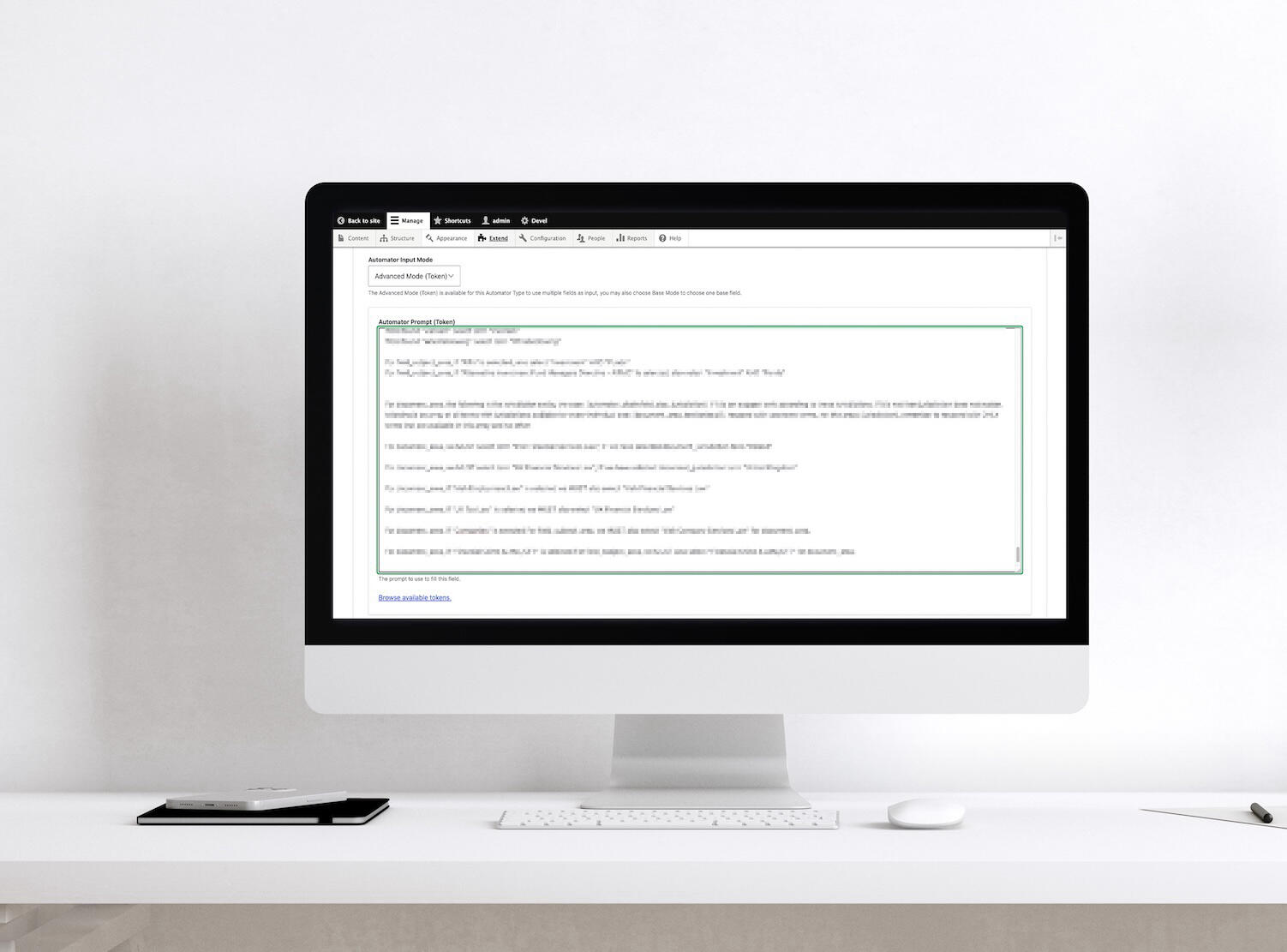
- Providing complete taxonomy lists within the prompt context.
- Specifying exact JSON output formats for consistent parsing.
- Adding validation rules and edge case handling.
- Testing with hundreds of real documents to refine accuracy.
How it works

The auto-fill feature
The solution integrates seamlessly into Better Regulation's existing Drupal 11 editorial workflow.
From an editor's perspective:
- Upload PDF: editor creates a new document entry and uploads the PDF to the "Original Document" field.
- Click "Generate with AI": single button click initiates the AI processing.
- Wait briefly: 10 seconds to 2 minutes depending on document size (no page refresh needed).
- Adjust if needed: editor can modify any field before saving.
- Save and publish: document is ready for the platform.
The experience transformation:
- Before: 15 minutes to multiple hours of reading and manual data entry.
- After: click a button, wait briefly, send a review.
Editors remain in control. They can modify any auto-populated field before saving. This preserves quality standards while eliminating the tedious work.

Fields automatically filled by AI
The system populates approximately 15 fields, including:
Text fields:
- Title - extracted and cleaned document title.
- Body/Summary - key content extraction from document.
Taxonomy references:
- Document type - statute, regulation, guidance, code, etc.
- Organization - issuing body or regulatory authority.
- Document area - subject matter classification.
- Document legislation - related legislative framework.
Entity references:
- Jurisdiction - UK, Ireland, EU, etc. (can be multiple).
Date fields:
- Year - when the document was enacted or published.
URL fields:
- Source URL - official publication location.
And additional metadata fields specific to Better Regulation's content model

The technical innovation: intelligent taxonomy mapping
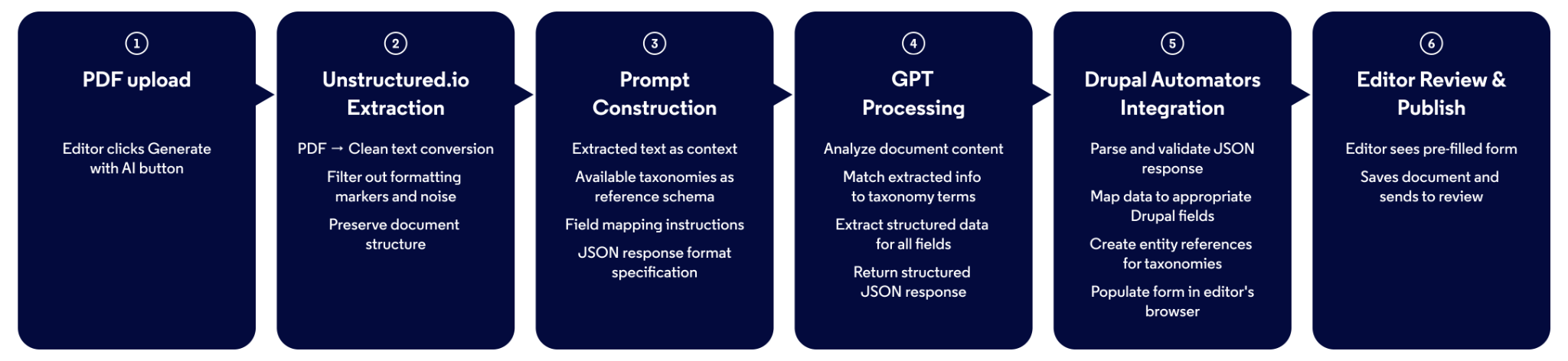
A key technical achievement is how the system handles Drupal's taxonomy references. The AI doesn't just extract text; it intelligently maps extracted information to existing taxonomy terms in the Drupal database.
Here's how it works:
- Context injection: the system includes the complete list of available taxonomy terms for each field in the prompt sent to the AI
- Semantic matching: the AI analyzes the document content and matches it against these terms based on meaning, not just keywords
- ID return: it returns not just the matched term names, but their specific Drupal entity IDs
- Entity reference creation: the Drupal Automators module then creates proper entity references using these IDs
This approach ensures:
- Seamless integration with Better Regulation's existing content architecture.
- No "orphaned" terms or data inconsistencies.
- Proper relationships between documents and taxonomies.
- Maintainable data structure as taxonomies evolve.
Technical architecture
The solution is built on a robust, production-ready architecture designed for reliability and scalability.
Technology stack:
Drupal 11 - content management platform
Drupal Automators (contrib module) - orchestrates the AI workflows and manages processing logic
Unstructured.io (Extracture) - PDF text extraction and cleaning, self-hosted for control
GPT (OpenAI) - language model for text analysis and categorization
RabbitMQ - message queue for background processing (used for summary feature)
Watchdog - comprehensive logging and error monitoring
Processing flow:
Key technical decisions
| Challenge | Solution | Rationale |
|---|---|---|
| Complex PDF formatting | Unstructured.io | Superior filtering of PDF artifacts, better handling of tables and multi-column layouts, higher extraction accuracy. |
| Model selection | GPT | Optimal speed/accuracy/cost balance, large context window (128K tokens) handles longest documents. |
| Output format | Structured JSON with schema | Ensures consistent, parseable responses; validates against expected field types. |
| Taxonomy matching | Include full taxonomy lists in prompt | AI can match semantically rather than by exact keywords; returns proper entity IDs. |
| User experience | Synchronous on-demand processing | Editors see immediate results; can verify before saving; no waiting for background jobs. |
| Large documents | Graceful degradation | Documents exceeding token limits flagged for manual review with clear error messages. |
| Reliability | Comprehensive error logging | All failures logged to Watchdog with context; admin dashboard shows processing status. |
Handling edge cases
The AI assists but doesn't replace human judgment. This multi-layered approach ensures that Better Regulation's high standards are maintained while gaining significant efficiency benefits.
Results: transformative efficiency gains
50% time savings in document processing
The most significant and immediately measurable result is the dramatic reduction in time required to process documents.
Better Regulation achieves 50% overall time savings for the full document ingestion, categorisation, review and publication process.
1 FTE equivalent capacity freed
What used to be a full day's work for one editor is now completed in an hour. The AI handles the tedious part – reading and extracting information – while editors focus on verification and quality control.
This represents approximately one full-time equivalent (1 FTE) of editorial capacity that has been freed up for higher-value work.
Scalability without headcount growth
Perhaps most importantly for Better Regulation's business, the AI solution provides scalability that would have previously required proportional increases in staff.
Technical innovation: Drupal + AI success story
This project showcases the power of modern Drupal for sophisticated AI integration.