The Great SaaS Escape: Why 2026 Is the Year to Take Back Your Software
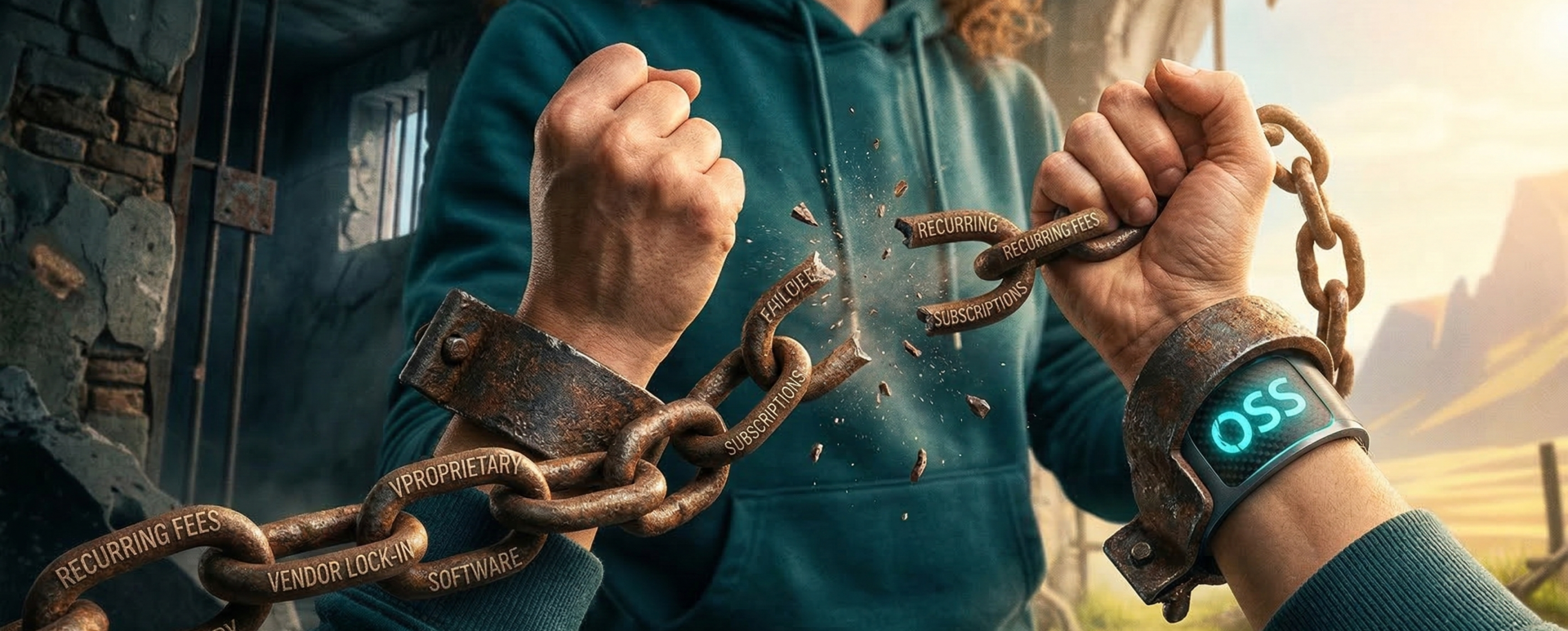
The Great SaaS Escape: Why 2026 Is the Year to Take Back Your Software
SaaS made sense when building software was expensive. That’s no longer the case — but your SaaS bill didn’t get the memo.
SaaS Made Sense. For a While.
Credit where it’s due — SaaS was a good deal for a long time.
Around 2015-2018, if your company needed marketing automation, the math was simple. You could spend $300,000 and wait 8 months for a custom build, or sign up for HubSpot at $500/month and launch campaigns next week. Need an intranet? A painful SharePoint project or a cloud tool that works out of the box.
No servers, no upfront capital, no IT headcount. Just a monthly fee. For most companies, that was the right call.
The whole model rested on one assumption: building your own software costs too much and takes too long. As long as that held true, paying rent made sense.
Two things changed.
SaaS Prices Keep Going Up
In 2025, the average SaaS price increase was 14.2%. General inflation? 2.7%. Software costs are rising at more than four times the rate of everything else.
73% of SaaS tools raised prices in 2025. Slack went up 20%. Salesforce’s top tier hit $500 per seat per month — double what it was five years ago. Forty-two vendors raised prices without even announcing it, averaging 18.7% in silent increases.
Per-employee SaaS spend went from $7,900 in 2023 to $9,100 in 2025. If your company spends a million on software, that’s an extra $122,000 per year for the same tools doing the same things.
You signed up for predictable costs. What you got is a bill that only goes up.
AI Changed the Build-vs-Buy Math
At the same time, the cost of building software dropped dramatically.
AI coding tools cut custom development costs by 50-70%. Not in theory — in production, right now.
- An MVP that cost $25-35k? Now $12-18k.
- A mid-complexity platform? From $150k to $70-90k.
- Enterprise scale? From $250k to $115k.
Developer productivity went up 76% in one year. 84% of developers use AI coding tools daily. Feature build time dropped by 70%.
Work that took a 10-person team 6 months now takes 3 people in 6 weeks.
So the original justification for SaaS — building is too expensive — doesn’t hold anymore. SaaS costs go up 14% per year while building costs dropped 50-70%. The breakeven on build-vs-buy moved from 3 years to 6 months.
This is already happening at scale. Retool’s 2026 Build vs. Buy Report found that 35% of enterprises have already replaced at least one SaaS tool with custom-built software. 78% plan to build more this year.
SaaS vendors see this. That’s why they all rushed to add “AI features” in 2025 — mostly a ChatGPT wrapper on existing data. But the real threat to SaaS isn’t AI inside their products. It’s that AI makes their customers capable of building something better without them.
You Don’t Start From Zero. Open Source Does the Heavy Lifting.
Moving off SaaS doesn’t mean writing everything from scratch. Mature open-source platforms already exist for most of the tools companies overpay for. They’ve been developed for years, used by thousands of organizations, supported by large communities. You start with a 90% complete product and customize the rest to fit your needs.
Instead of HubSpot — Mautic. Full marketing automation: email campaigns, workflows, landing pages, forms, segmentation, lead scoring. Over 200,000 installations worldwide. The key difference: no per-contact pricing. Your list grows to 500,000 contacts and your cost stays the same.
Instead of SharePoint — Open Intranet on Drupal. Company news, document management, employee directory, team spaces, knowledge base. No per-user licensing. Add 200 contractors for a project — no extra cost. On SharePoint at $40/user/month, those 200 contractors run $96,000/year.
Instead of proprietary CMS — Drupal. Used by some of the world’s largest websites, backed by 1.3 million developers. Drupal’s AI module integrates 48+ AI providers directly into content editing — content creation, one-click translations, automated workflows. Not a paid add-on. Built in.
There’s a compounding effect here: AI coding tools work extremely well with these open-source codebases. They write modules, debug workflows, generate tests, handle security patches. The old argument against open source — “maintenance is expensive” — doesn’t apply the way it used to. AI reduced that cost to a fraction of what it was.
Others Have Already Done This
In October 2022, DHH — creator of Ruby on Rails, co-founder of 37signals — announced his company was leaving AWS. They were paying $3.2 million per year. A lot of people said it was a bad idea.
Three years later, 37signals has saved over $10 million. Their cloud bill dropped from $3.2M to under $1.3M annually. The $600,000 in servers was recouped in under a year. Performance improved 3-5x. By 2025, they were deleting their AWS account.
They also launched ONCE — software you buy once and own. No subscription, no renewals, no price increases.
DHH’s move was about cloud infrastructure, but the same principle applies to SaaS: when you run the real numbers, the gap between what you’re paying and what you could be paying is significant. Dropbox made a similar move and saved $75 million. 86% of CIOs now plan some form of cloud repatriation.
The Three Costs SaaS Vendors Don’t Talk About
Most companies evaluate SaaS by looking at the monthly invoice. But there are two other costs that add up fast.
Compounding prices
Your SaaS bill increases every year. At 14% average increases, a $2,000/month tool becomes $3,900/month in five years. Over that period, you pay $208,000 for what was supposed to cost $120,000.
Open-source costs are the opposite. Upfront investment in year one, then a flat annual cost for hosting and support. Year 1 is the most expensive. Year 5 is the cheapest.
A concrete example: a company paying $5,500/month for HubSpot Marketing Hub Enterprise ($66,000/year) migrated to Mautic. Implementation: $22,000. Annual hosting and support: $9,000. Five-year total: $58,000 vs. $405,000 on HubSpot (with 14% annual increases). That’s $347,000 in savings.
Vendor lock-in
Every year on a SaaS platform, leaving gets harder. Data accumulates in proprietary formats. Workflows rely on vendor-specific features. Integrations only connect within that ecosystem. This is by design — your switching cost is their moat.
With open source, you own the code, the data, and the infrastructure. Want to change your implementation partner or hosting provider? You can. No one’s permission required.
Lost flexibility
After a couple of years on any SaaS platform, your team’s processes reshape around the tool’s limitations. The workaround becomes the process. The export-to-Excel becomes “the report.” The 4-click detour becomes “how we do things.”
You submitted a feature request in 2024? It’s still “under consideration.” Meanwhile, your team spends hours every week on workarounds that a custom platform wouldn’t need.
How to Approach This
This isn’t about flipping everything overnight. Start with the tools where the gap between cost and value is largest.
1. Audit your SaaS stack. List every tool, its monthly cost, annual cost, and projected 3-year cost at 12-15% annual increases. Most companies are surprised by the total.
2. Find your worst deal. Which tool costs the most relative to what it delivers? Common candidates: marketing platforms where you pay per contact but 70% are dormant. Intranets where you pay per user but half the company logs in once a week.
3. Run a real comparison. For that one tool, compare 3-year TCO. Include all SaaS tiers, add-ons, and projected increases. On the open-source side, include implementation, migration, hosting, and support. Use actual quotes.
4. Start with a pilot. Migrate one team or one use case. Not the whole company.
5. Scale from there. Each successful migration builds confidence and compounds the savings.
SaaS Isn’t Dead. But the Default Is Broken.
SaaS will remain the right choice for commodity tools with low customization needs — project management, team chat, video calls.
But for core business platforms — marketing automation, CMS, intranet — the economics have changed. AI made building affordable. Open source made it fast. Together, they give companies a real alternative for the first time in a decade.
Companies that reassess their SaaS stack in 2026 will save hundreds of thousands over the next five years. They’ll own their data, control their roadmap, and move faster than competitors stuck on rigid platforms.
Companies that don’t will keep paying 14% more every year for the same tools with the same limitations.
At Droptica, we help companies move from expensive SaaS to open-source platforms. Mautic instead of HubSpot. Open Intranet instead of SharePoint. Drupal instead of proprietary CMS. If you want to see what the numbers look like for your stack, reach out.
Sources:
- SaaS Price Pulse Q1 2026 Report — 73% of tools raised prices, 42 silent increases
- Vertice SaaS Inflation Index — 14.2% average price increase vs. 2.7% market inflation
- SaaStr: The Great SaaS Price Surge of 2025 — Slack +20%, Salesforce $500/seat
- DHH: Cloud Exit Savings Top $10M Over Five Years
- The Register: 37signals On-Prem Migration
- Retool 2026 Build vs. Buy Report — 35% of enterprises replaced SaaS with custom software
- Index.dev: AI Tools Cutting Development Costs — 50-70% cost reduction
- Inspectural: DHH Was Right Analysis — 86% of CIOs planning cloud repatriation