
9 open source email marketing platforms


Are you looking for an open source email marketing platform your team can run with more control over data, integrations and costs? In this updated guide, I compare nine tools for mailing lists, newsletters, marketing automation and email delivery—from Mautic and phpList to Postal, Mailtrain, CiviMail and listmonk. Some are full marketing platforms; others focus on one job, such as newsletter management or transactional delivery.
Before you compare vendors, it helps to know what a newsletter program needs from list growth through send analytics. The platforms below sit at different points on that spectrum.
In this article:
- What features should good email marketing software include?
- Why choose open source email marketing platforms?
- Which 9 open source email marketing platforms should you compare?
- How do you choose the right open source email tool?
- Want to implement Mautic or connect email with your Drupal site?
What features should good email marketing software include?
Email remains one of the most direct channels between a brand and its audience. Well-run campaigns support onboarding, product updates, event invites and sales follow-up. Weak tooling shows up quickly as low engagement, list churn or deliverability problems.
At minimum, email marketing software should let you create and send messages with a WYSIWYG editor and reusable templates. Templates speed up layout work—columns, images, styles—so teams spend time on copy rather than HTML. Anti-spam checks before send are useful too: they flag content that may hurt inbox placement while you can still edit the draft.
For anything beyond one-off broadcasts, look for list segmentation. Group contacts by behavior, source, product interest or custom fields, then tailor subject lines and body content. Reporting should cover opens, click-through rate (CTR), unsubscribes and bounces so you can iterate. For background on automation workflows, see what email marketing automation is and how to use it.
Many teams eventually connect email to a broader stack: CRM data, web forms, product events and retargeting. Platforms with automation, scoring and multi-step journeys reduce manual handoffs. Even if you start with simple newsletters, plan for how lists stay clean—email list management best practices apply whether you self-host or use SaaS.
Why choose open source email marketing platforms?
Open source email tools are often free to license; your main costs are hosting, implementation, integrations and ongoing maintenance. That model suits teams that want to own subscriber data, audit code paths or extend behavior without vendor lock-in.
Because source code is available, developers can adapt workflows, connect custom modules and fix issues on their timeline. For many organizations, self-hosting is less about avoiding subscription fees and more about control over data residency, deliverability settings and release cycles. If your company already favors open stacks for CMS or CRM, email is a natural next layer—see also why it is valuable to use open source web technologies.
Open source does not mean zero operational work. You still need backups, security patches, SMTP reputation and monitoring. Compare total cost of ownership against SaaS before you migrate a live list.
Which 9 open source email marketing platforms should you compare?
Not every tool below plays the same role. Some are full open source email marketing platforms with automation; others handle only lists, delivery or CRM-triggered mailings. Use this section as a shortlist, then validate against your volume, team skills and integration needs. For a wider automation landscape, read five marketing automation platforms you should know.
GNU Mailman
GNU Mailman is a free, open source Python application for mailing lists and discussion groups. It is strong at list moderation, archives and subscription management rather than visual campaign design.
Mailman includes scheduled sending, bounce handling and multilingual support. You can integrate it with a website so sign-ups feed the same list your messages use. Teams that need classic list-server behavior—announcements to members, moderated threads—often pick Mailman before they need a marketing automation suite.
OpenEMM
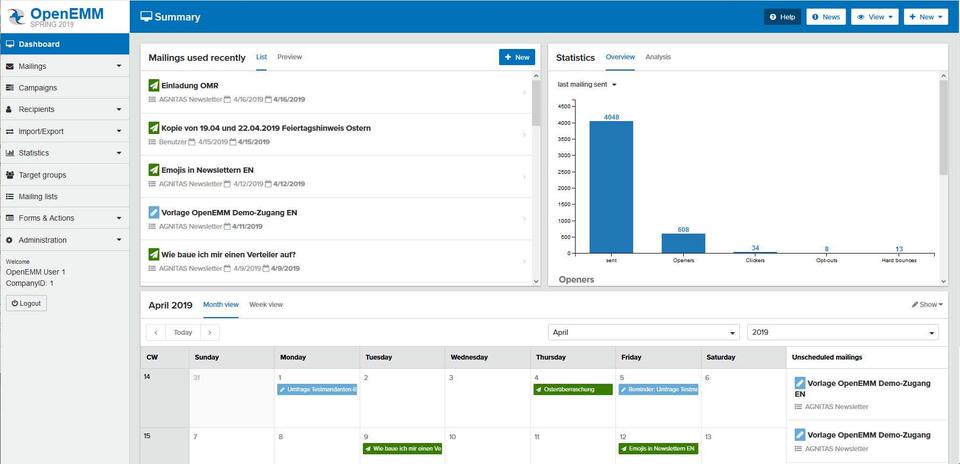
OpenEMM is open source email marketing software without subscriber or send limits on self-hosted deployments. The interface supports templates, personalization and responsive layouts for campaign work.
Source: OpenEMM
Real-time campaign statistics help you track performance; bounce management keeps lists healthier over time. Beyond newsletters, OpenEMM can send transactional messages and autoresponders. Built-in calendar and filtering help marketers organize drafts and scheduled sends.
SendBlaster
SendBlaster appears in many comparison lists because of its free edition and template library, but it is proprietary freeware—not open source software. We include it here only because teams still evaluate it next to self-hosted tools. If license freedom and code access matter, prefer the other platforms in this guide.
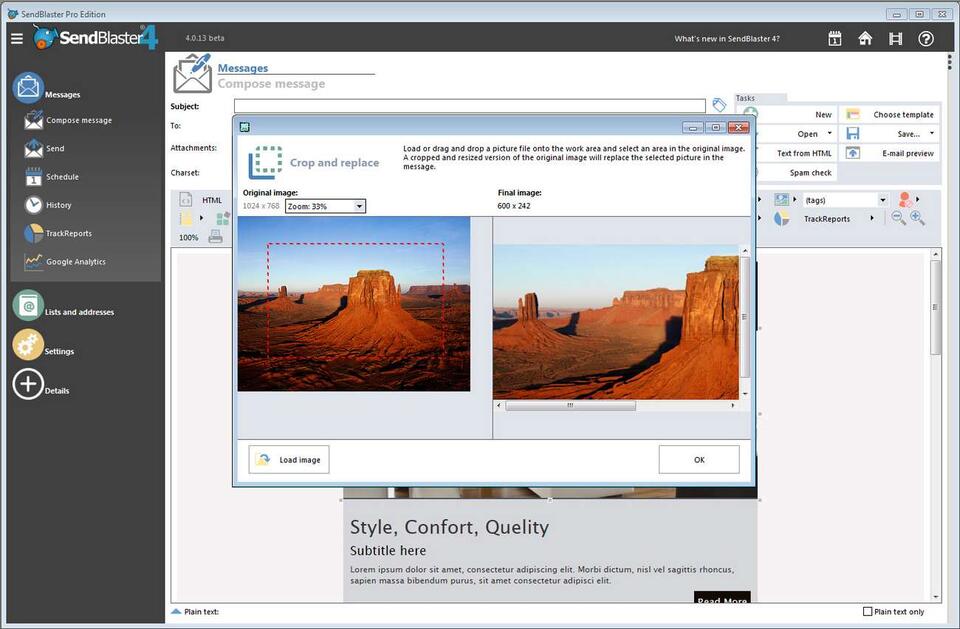
SendBlaster runs as a desktop application (primarily on Windows) with a template editor, opt-in list handling and bounce management. The paid Pro license adds personalization and segmentation. It integrates with Google Analytics for send tracking.
Source: SendBlaster
phpList
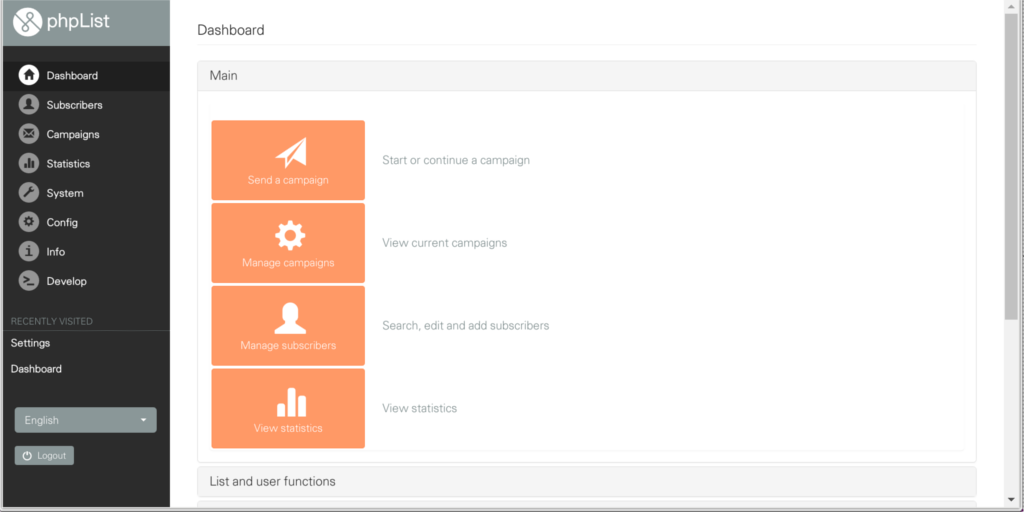
phpList is available in two models: phpList.org offers the open source, self-hosted mailing program, while phpList.com provides hosted plans with different feature tiers. For a fully open source email marketing setup, use the self-hosted edition.
Source: phpList
phpList handles bounces, subscriber history, segmentation and campaign analytics. It fits teams that want a mature list-centric tool without the scope of full marketing automation. Pair it with solid list-building practices—see how to build your email list—before you scale sends.
Mautic
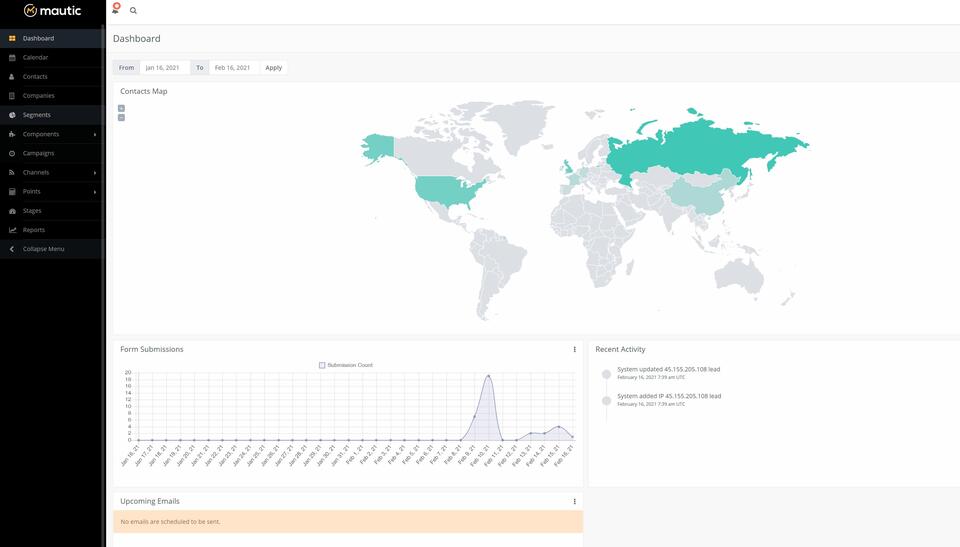
Mautic is an open source marketing automation platform with email at its core. Self-hosted Mautic does not cap subscribers, lists or sends, which makes it viable for growing B2B and B2C programs.
Source: Mautic
Mautic tracks visitor behavior on your site, builds contact profiles and supports segmentation from that data. You can send bulk, transactional and one-to-one messages with dynamic content blocks that change per subscriber. For a practical personalization pattern, see our guide to Mautic dynamic content.
Postal
Postal is not a classic newsletter builder. It is an open source mail delivery platform for websites and web applications—the self-hosted equivalent of SendGrid, Mailgun or Postmark.
Postal fits when your team needs control over outgoing mail infrastructure, logs, webhooks and delivery settings. It supports transactional email, application notifications and technical mail flows. Marketing teams usually pair Postal with a separate campaign editor rather than using it as the primary creative interface.
Consider Postal if:
- Self-hosted delivery: you need your own SMTP/API layer with full logs.
- Transactional volume: applications generate most outgoing mail.
- Technical ownership: DevOps wants queues, webhooks and reputation control.
- Split stack: another tool already handles campaign design.
Skip Postal as your main pick if marketers need a visual campaign builder in the same product.
Mailtrain
Mailtrain is a self-hosted newsletter application built with Node.js and MySQL or MariaDB. It targets list management, subscriber preferences and newsletter campaigns on infrastructure you control.
Mailtrain suits teams that want a focused newsletter tool without moving subscriber data to commercial SaaS. Validate template editing, automation and reporting against your requirements before commit—it is lighter than Mautic by design.
Consider Mailtrain if:
- Newsletter-first: broadcasts matter more than multi-channel journeys.
- Node.js ops: your team can deploy and patch a Node application.
- Internal lists: subscribers stay on your servers and databases.
- No full automation suite: you do not need CRM-grade journeys yet.
CiviMail / CiviCRM
CiviMail is the mass-email component of CiviCRM. NGOs, associations, membership bodies and institutions often use it when contacts, events, memberships and donations already live in CiviCRM.
Its strength is context: send targeted mail from the same database that stores member history—no CSV export to a separate ESP. CiviMail supports large mailings and campaign reporting tied to CRM records.
Consider CiviMail if:
- CRM-native lists: CiviCRM is already the system of record.
- Member and donor mail: audiences map to CRM groups and activities.
- Segmentation from CRM fields: filters use membership, events or giving data.
- Unified history: email results sit next to contact timelines.
listmonk
listmonk is a self-hosted newsletter and mailing list manager distributed as a single binary with PostgreSQL. The project is actively maintained; the public site listed version 6.1.0 in March 2026.
listmonk is a strong pick when you want a fast, lightweight newsletter tool without the weight of full marketing automation. It focuses on lists, campaigns, templates and throughput—useful for publications, product updates and content-led email programs.
Consider listmonk if:
- Lightweight stack: you want simple deployment and low overhead.
- PostgreSQL: your team already runs or prefers Postgres.
- Performance: high-volume sends with direct data control matter.
- Editorial programs: recurring content mailings are the main use case.
How do you choose the right open source email tool?
Start with the job, not the brand. Mautic fits when you need marketing automation, scoring and multi-step journeys across channels. phpList, Mailtrain and listmonk sit closer to newsletter and list management. CiviMail makes sense when CiviCRM already holds contact data. Postal is delivery infrastructure, not a campaign studio. GNU Mailman serves classic list-server workflows; SendBlaster is optional freeware if you accept a proprietary desktop tool.
Map requirements to skills on your team: who will patch servers, monitor bounces, design templates and wire forms on the site? A short email marketing strategy document prevents buying hosting for a platform nobody maintains.
Read also: nine best newsletter designs and key template elements and email marketing campaign examples for creative patterns once the platform is chosen.
Want to implement Mautic or connect email with your Drupal site?
Droptica implements and maintains Mautic for clients that need self-hosted marketing automation, Drupal integrations and reliable handover to in-house teams. We connect forms, tracking, segmentation and email flows so web content and campaigns share the same contact model.
Planning a self-hosted email stack alongside Drupal, CiviCRM or custom applications? We help with architecture, deployment and long-term support. Visit our Mautic services page or Drupal development services to discuss your project.